Probability for Quant Interviews
What This Book is About
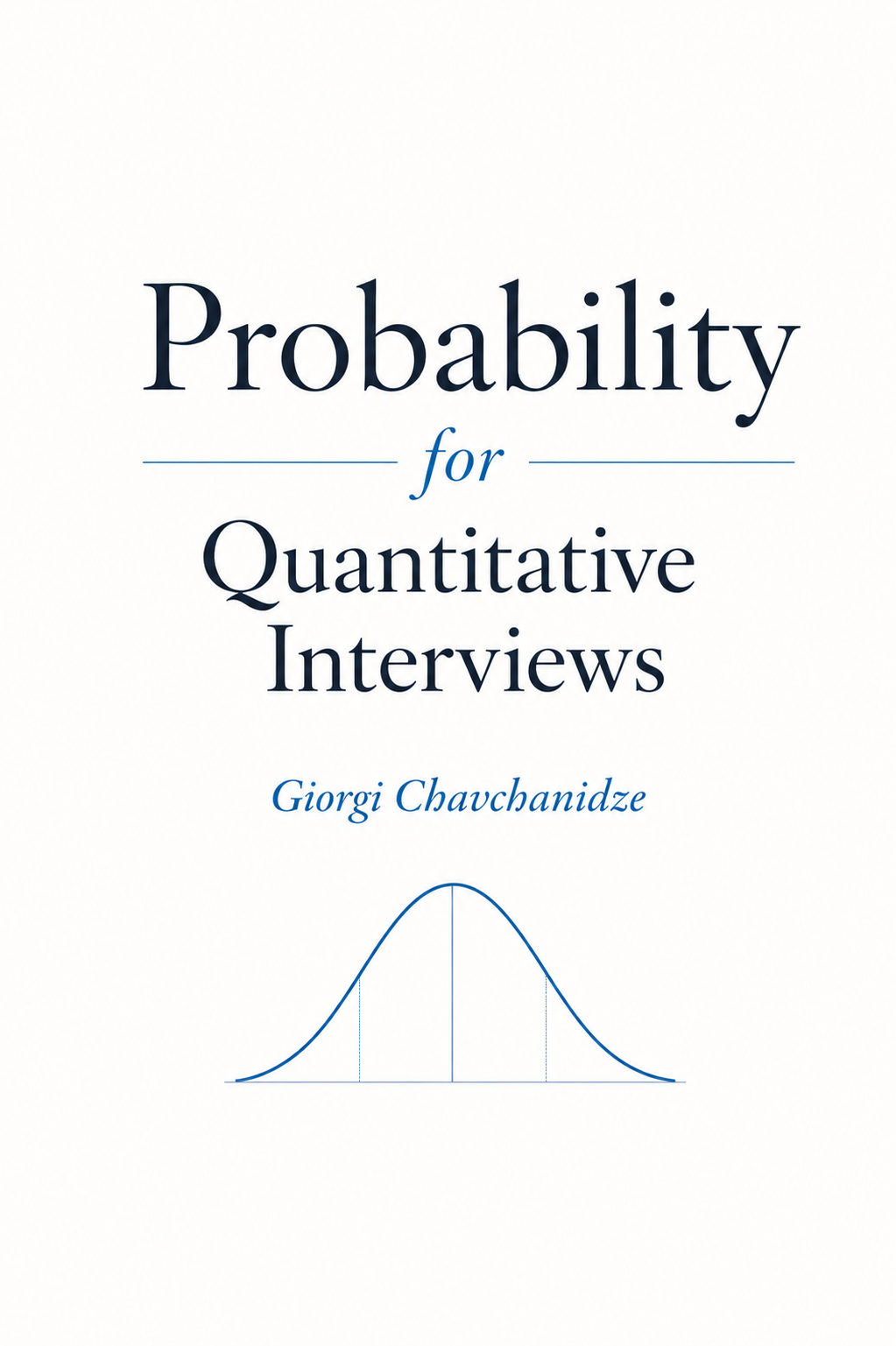
The book develops Probability Theory around the types of problems asked in Quantitative Finance probability interviews and assessments. You can think of it as a high-quality Probability textbook that
1) is stripped of Probability material unlikely to be relevant for interviews,
2) serves as a single consolidated space for all interview-relevant concepts a reader can get back to at their convenience,
3) relies on mathematical formalism while always translating key insights to intuitive English, and
4) offers generalized discussion of problem-solving tricks and techniques.
Who This Book is For
While primarily targeted at the individuals preparing for Quantitative Finance Probability assessments and interviews (see "What This Book is About" section), the book is useful for anyone looking for a quick and intuitive introduction to a wide range of probability concepts. It will also help undergraduate and graduate students who might find standard textbook language too formal and unintuitive.
More Than a Book
A buyer of the book does not simply get access to an electronic copy of the book. They also get access to all future updates and an ability to interact with the author and ask any clarifying questions. Hence, buyers get a lifetime subscription to a dynamic resource rather than a static copy of a book.
Readers are welcome to request content additions or solutions to specific problems they find challenging. I strive to respond to all such requests as soon as time allows.
Value of the Book Relative to Existing Resources
There are a few excellent Probability textbooks (e.g. "Introduction to Probability" by Blitzstein and Hwang) and a few excellent books written specifically for Quant interview preparation (e.g. "Heard on the Street" and "Practical Guide to Quantitative Finance Interviews"). OpenQuant also provides a free large problem set with solutions and practice tests.
However, standard Probability textbooks are an overkill for interview preparation, because they are written for a wide range of audiences with the scope and depth that can quickly overwhelm a reader who is primarily preparing for the Probability assessments (nor would a reader know in advance which parts of the textbook would be most relevant to them).
In contrast, books or online resources written or created for interview preparation either focus on problems solutions only and skip theory altogether, or scatter theoretical discussions across solutions rather than provide a single exhaustive resource that develops all relevant concepts from ground up.
Moreover, students from my experience often look for generalizability in problem solving approaches and try to draw parallels between similar problems and approaches. Being able to take solution methods beyond the immediate context of a problem is also a feature prospective employers greatly value and is an edge in the recruitment process. Students with insufficient Probability background might find it hard to develop this skill within reasonable timeframe based on individual problem solutions alone, which is what existing prep resources are constrained to, unfortunately.
The Probability for Quantitative Interviews is written exactly with the aim of filling these gaps in existing prep resources and its novel design (see "More Than a Book" section) provides additional conveniences for readers along the way.
Reading Experience
The book can be accessed on any device using any modern browser with a built-in PDF reader, and it comes with clickable links for easy navigation to and from sections and equations.
How to Get the Book
The book is in the final stages of production. Starting in September, you can get a free temporary 1-week access to the working version by emailing [email protected]. In the email, you must indicate your interest in and the expected benefit from the book, as well as how you came across it. You will get the temporary access link only if the interest and expected benefit are clearly explained. The access can be extended by another week each time you provide useful feedback about the book. The feedback can include comments about the usefulness of existing content, thoughtful clarifying questions about material and suggestions about future content.
Institutional Disclaimer
The book is an independent work and is not associated with any of my current or former institutions.